
Uni&Core Skincare: The Science Behind Pure Vitamin C Stability & Brightening

Uni&Core Skincare: The Science Behind Pure Vitamin C Stability & Brightening
When people search for Uni&Core Skincare, they’re usually looking for more than product names. They want to understand what actually makes the formulations different.
In Part 1 of our latest Uni&Talk video, we break down the real science behind Uni&Core Pure Vitamin C — focusing on stability, pH balance, mask formulation challenges, and ingredient synergy.
This isn’t marketing language. It’s formulation science.
Watch the full video here:

Dr. Cho Byung Gi is a renowned Korean cosmetic scientist and R&D leader with more than four decades of experience in skincare research and formulation. He holds a Ph.D. in Chemistry from Pusan National University, an M.S. in Chemistry from KAIST, and a Ph.D. in Food Science and Biotechnology from Kyungnam University.
Throughout his career, Dr. Cho has led research and product innovation for many of Korea’s most influential beauty companies, including:
Head of R&D Center, Amorepacific Corporation (17 years)
Director, Coreana Cosmetics R&D Center (9 years)
Director, Nature Republic R&D Center (3 years)
Director, OMEY R&D Center (4 years)
Director, Jayjun Cosmetic R&D Center (2 years)
Director, The Face Shop R&D Center (5 years)
CEO, Dermstory (2019–Present)
He is recognized for pioneering achievements in Korean skincare, including the development of the world’s first successful stabilized vitamin C formulation and the introduction of Korea’s first cosmetic application of retinol (Vitamin A). His work has helped shape iconic product lines and key technologies now considered foundational in the K-beauty industry.
With this background, Dr. Cho explains why many modern vitamin C serums struggle to deliver real whitening—beginning with the most basic requirement: true solubility.
Why Uni&Core Skincare Focuses on Vitamin C Science
The video begins by establishing where Vitamin C stands among anti-aging ingredients.
Retinol (Vitamin A) ranks first for wrinkle improvement.
Vitamin C ranks first for skin brightening.
For collagen synthesis and structural support, Vitamin C ranks second after retinol.
This is why Uni&Core Skincare places strong emphasis on properly formulated Vitamin C — not just for improving tone, but for supporting overall skin structure.
The Stability Problem: Why Pure Vitamin C Is Difficult to Formulate
Pure Vitamin C (ascorbic acid) has one major challenge: instability.
Chemically, Vitamin C carries a negative charge. When dissolved in water, it becomes ionized. Once ionized, it becomes unstable.
That instability means:
It oxidizes
It darkens
It can develop odor
It gradually loses effectiveness
This is one of the biggest formulation challenges in skincare.
That’s why most Vitamin C products are packaged in:
Small containers
Narrow openings
Minimal air exposure
Air accelerates oxidation. Less air improves stability.
Understanding this principle is foundational to how Uni&Core Skincare approaches Vitamin C formulation.
The Double-Coating Concept Explained
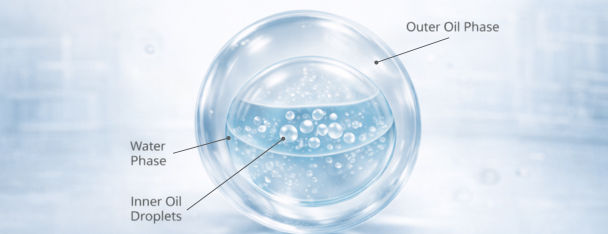
To reduce ionization in water, the video explains a double-coating approach:
First applying a positive charge
Then applying a negative charge
This layered structure helps prevent rapid ionization when Vitamin C is exposed to water, improving stability.
While many brands focus heavily on percentage claims, Uni&Core Skincare emphasizes molecular behavior and formulation logic — because stability determines whether the ingredient is still active by the time it reaches your skin.

Low pH vs. Skin Irritation: The Real Formulation Balance
Another major point discussed is pH.
Lower pH increases Vitamin C efficacy.
Lower pH also increases skin irritation.
Many competitor products remain around pH 3.7 because going lower increases irritation risk and formulation difficulty.
Achieving a lower pH (such as 3.45) while minimizing irritation requires careful ingredient support and soothing components.
This isn’t about making a formula “stronger.” It’s about balancing efficacy, solubility, and skin tolerance.
That balance is central to the philosophy behind Uni&Core Skincare.

Ampoule-type Vitamin C products are common worldwide. Pure Vitamin C mask sheets are not.
Mask pouches contain distributed air inside the packaging. That air significantly increases oxidation risk.
In early experimentation, instability occurred within days when Vitamin C solution and sheet were sealed together in a pouch.
Maintaining stability in a pure Vitamin C mask sheet is far more difficult than in a small bottle with a narrow opening.
This is the technical background behind the Uni&Core Vita-C Brightening Mask, which is referenced in the video as a pure Vitamin C mask sheet formulated with stability in mind.

The video then transitions into ingredient synergy.
Vitamin C contributes to brightening by influencing melanin tone — helping convert darker pigment into a lighter form.
Glutathione is another well-known brightening ingredient.
When combined:
Brightening efficacy increases
Skin irritation may decrease
You gain dual mechanisms instead of relying on one
This synergy is demonstrated through the Uni&Core Vita-C Glutaglow Super Brightening Ampoule.
Uni&Core Skincare focuses on ingredient interaction, not just ingredient presence.


Comments